


In construction projects, concrete serves as the "skeleton" that supports the implementation of the project. The stability of its supply and the reliability of its quality directly determine the safety, progress and cost control of the project. For large-scale engineering projects, concrete mixing plants have long been a "standard configuration" in the supply chain rather than an option.
Why do many large-scale engineering projects have to use stationary mixing plants to mix concrete instead of flexible concrete mixer trucks? Perhaps it is not as simple as imagined. The answer lies in a series of core advantages tailored for engineering construction by concrete mixing plants, ranging from quality control to efficiency improvement, from cost savings to service adaptation, comprehensively addressing the core demands of construction sites for concrete supply.

Why Must Construction Sites Use Concrete Batching Plants?
Insufficient Production Capacity
Large construction sites have a continuous and substantial demand for concrete. However, concrete mixer trucks, constrained by their limited single-load capacity, require frequent trips back and forth. This inherent bottleneck can easily lead to delays in construction progress.
Requires A Large Number of Support Vehicles
Concrete mixer trucks cannot independently complete the entire construction process and must rely on auxiliary vehicles such as loaders and pump trucks for cooperation. In large-scale projects, if only mixer trucks are relied upon, a large number of vehicles need to operate simultaneously on site, making the dispatching complex and easily causing congestion at the construction site.
Cost and Management Inefficiency
Relying solely on mixer trucks as "fixed mixing equipment" requires a large number of vehicles and workers to be equipped simultaneously, resulting in high fuel consumption and maintenance costs. Moreover, the site dispatching and management are complex, increasing the difficulty of construction. Fixed mixing plants can reduce the input of labor and equipment, and the overall cost is more advantageous.
Reasons for Not Mixing Concrete on Site
In terms of engineering quality, the dust, noise and wastewater discharge generated during the on-site mixing process are difficult to be effectively controlled. Moreover, the randomness of manual proportioning and on-site mixing is relatively large, which can easily lead to hidden dangers such as uneven and insufficient concrete.
From the perspective of construction efficiency, the production capacity of on-site mixing is limited, which will restrict the overall progress of the project and may also cause quality problems such as structural cold joints due to supply disruptions.
In addition, the accumulation of a large amount of raw materials such as sand, gravel and cement not only occupies the construction space, but also increases the safety risks during the material handling process and the difficulty of on-site dust management.

Core Reasons for Selecting a Stationary Mixing Plant at Construction Sites: Based on Project Requirements
First and foremost, the most significant feature of a batching plant is its quality assurance, which helps mitigate potential hazards in building materials. The quality of an engineering project is directly related to the quality of concrete.
The long-term safety of the structure, its designed service life, and even its seismic and damage resistance capabilities all highly depend on the performance of concrete. If non-standardized on-site mixing methods are adopted, it will inevitably cause multiple quality risks.
Secondly, the use of fixed concrete batching plants can effectively adapt to the construction rhythm, ensuring that concrete is supplied on time and in the required quantity, thereby guaranteeing that the project progress is controllable and the construction is smooth.
When supplying concrete independently on construction sites, problems such as waste of raw materials, high labor costs, and heavy burdens on equipment purchase and maintenance are often encountered.
Fixed concrete mixing plants can effectively control construction costs by precisely quantifying waste, reducing labor input through automated operations, lowering transportation costs through centralized production, and achieving resource recycling.
A comparison Between a Mixing Plant and On-site Mixing
|
Comparison Dimensions |
On-site Mixing |
Concrete Batching Plant Supply |
|
Quality |
Significant mixing ratio errors lead to unstable quality |
Automated production, consistent quality |
|
Efficiency |
Slow speed, making continuous construction difficult |
Large production capacity, continuous supply |
|
Environmental Protection |
Severe dust and noise pollution |
Supporting facilities, compliant emissions |
|
Safety |
Raw materials are piled up in disarray |
Centralized transportation, low risk |
The Advantages of Fixed Batching Plants
1. Consistent Quality: Standardized Production
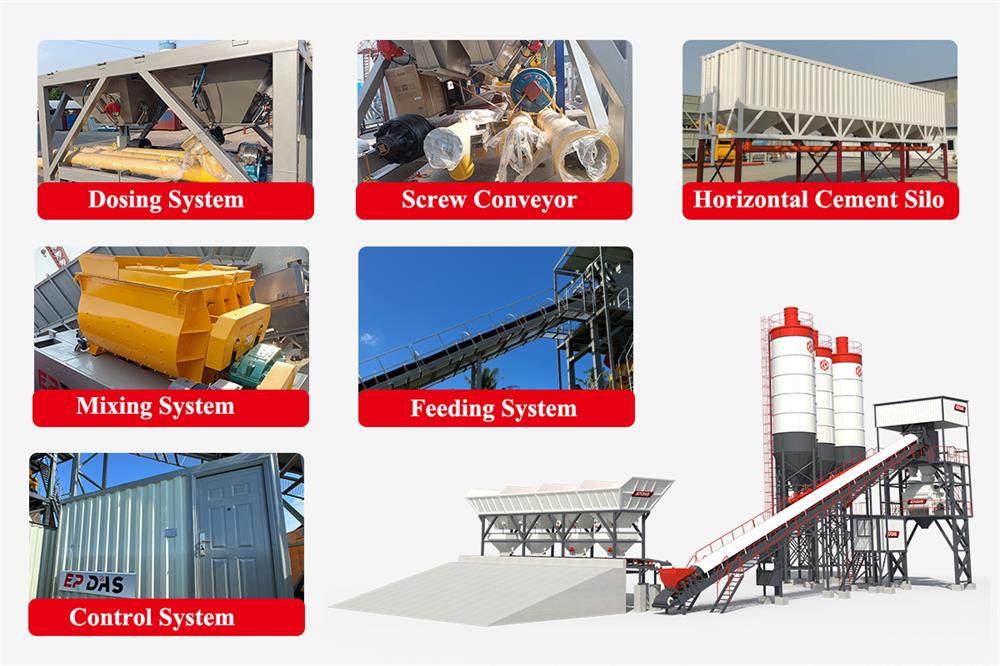
Fixed concrete mixing plants are equipped with advanced automatic metering and mixing systems, which can precisely control the proportion of materials and reduce human errors. At the same time, a high-efficiency mixing host is adopted to ensure the uniformity and strength stability of the concrete, continuously outputting high-quality concrete that meets the standards.
2. On-demand Production: Flexible Adaptation
Equipped with an intelligent control system, it can quickly switch production formulas and adjust output to meet the demands of different construction stages, achieving flexible adaptation and efficient supply.
3. High-efficiency Production and Transportation: Scaling up + Centralization
Centralized procurement and transportation of raw materials → in-station mixing → dedicated vehicle delivery of finished concrete. Large-scale mixing hosts, multiple production lines running in parallel, automated feeding systems, control of initial setting time of concrete, and adjustment of delivery speed as needed.
4. Significant Cost Savings
The use of fixed concrete mixing plants can control the costs of labor, materials and equipment. Only a small number of core personnel such as equipment monitoring, technical maintenance, and dispatching management are needed. The proportioning error is controlled within an extremely low range to avoid excessive consumption, and there is no need to purchase large-scale mixing equipment.
The Application Value of Mixing Plants in Different Construction Scenarios
▲ Large-scale Building Complex Project
Demand characteristics: Large demand volume, long supply cycle, supply by region and building, and different marking requirements at different stages
Advantages of mixing plant adaptation: large-scale production to meet total demand, flexible scheduling to adapt to regional supply, and simultaneous production of multiple grades of concrete.
▲ Infrastructure Projects
Demand characteristics: High demand for continuous pouring, complex construction environments, specialized concrete performance requirements.
Mixing plant adaptation advantages: Centralized transportation ensures continuous supply, customized formulations meet specialized performance needs, delivery capabilities adapt to complex environments.
▲ High-Rise Construction Projects
Demand characteristics: High concrete strength requirements, great difficulty in vertical transportation, and high demand for supply timeliness.
Advantages of the mixing plant adaptation: stable production capacity of high-grade concrete, coordination with vertical transportation equipment on the construction site (such as concrete pump trucks), and precise control of supply time.

Conclusion
The quality foundation of an engineering project begins with the outstanding quality of concrete. Fixed mixing plants fundamentally ensure the stability of concrete performance through standardized production. With their significant advantages in guaranteeing concrete quality, achieving cost-effectiveness, and providing customized services, they have become an indispensable core link in modern large-scale engineering projects.
When planning your next major project, choosing a fixed concrete mixing plant and the professional supplier behind it means you are selecting not just a building material, but a comprehensive solution covering quality, efficiency and cost. As a professional supplier, EPDAS can meet all your concrete mixing plant needs. Contact us for more information.


