


In construction and agricultural projects around the world, efficient and high-performance engineering machinery has always been the core force driving the progress of work. Among various devices, telescopic arm brakes, with their outstanding flexibility and multi-functionality, have become indispensable key equipment in modern construction and agricultural production. In the face of diverse working conditions, choosing the appropriate model not only directly affects the project schedule and cost control, but also concerns the overall quality and safety of the project.
Currently, there are various types of telescopic boom forklifts on the market, and each model is designed with unique functions for different application scenarios. Gain a thorough understanding of its classification and advantages to significantly enhance work efficiency. If you are looking for a device that can handle high-altitude, confined and complex construction environments simultaneously, the telehandler will be your best partner.
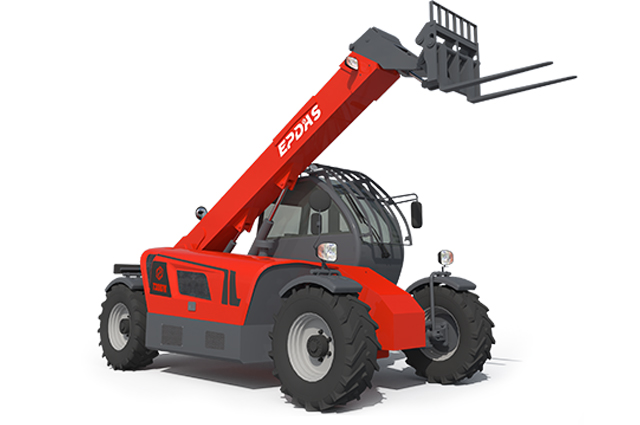
The Core Essence of Telescopic Boom Forklifts
The telescopic forklift is a multi-functional construction machinery with a hydraulic system as its core power. Its core feature lies in achieving the compound actions of "lifting and extending forward and backward" through the telescopic boom, and it can quickly replace various attachments.
The core structure consists of three major components:
1. Telescopic boom assembly
Composed of multiple nested boom sections, it can achieve extension and retraction.
2. Chassis system
It is divided into wheeled chassis (general type) and tracked chassis (special terrain dedicated), ensuring passability in complex terrains.
3. Attachment interface
It adopts a standardized quick-change device, which can quickly switch between different attachments and is the key to achieving "one machine with multiple uses".
The core difference from traditional equipment
| Comparison Dimension | Telescopic Forklift | Traditional Forklift | Minor Crane | Loader |
| Operational Height | 5 to 20 meters | 2 to 5 meters | 10 to 30 meters | 2 to 4 meters |
| Material Handling Type | Pallet, bulk, heavy object hoisting | Pallet cargo only | Only heavy object hoisting | Only bulk materials |
| Terrain Adaptability | Flat ground + rough terrain | Only for flat ground | Level the ground and fix the outriggers |
Ordinary unpaved ground |
| Equipment Input Cost | One device |
Requires crane / loader |
Requires a forklift / loader |
Requires forklift / crane |
The Main Types of Telescopic Boom Forklifts
Standard Fixed Boom Telehandlers
Standard fixed telescopic boom forklifts can only perform "lifting and lowering + forward/backward extension" movements without rotation. Their structure is relatively simple, offering strong vehicle stability. While lacking overall mobility, they fully retain the core functions of a retractable boom and quick-change attachments. Compared to rotating models, they change working direction by moving the entire vehicle, resulting in a more streamlined design.
Rotating Telehandler
The rotary telescopic boom forklift is a highly flexible and multi-functional type of mechanical equipment. Its main features lie in its ability to move flexibly. It is equipped with a 360° rotary platform and can perform full-angle rotation work. But, the lifting capacity of the telehandler has certain limitations and mainly focuses on flexible operation.

Off-Road Heavy-Duty Telehandler
The off-road heavy-duty forklift with extendable boom is a high-load-bearing and multi-functional construction machinery. It can not only transport and lift large items, but also work stably in muddy, sandy and stony or rough terrain. Equipped with large-sized off-road tires (wide tread and deep tread), a full-time four-wheel drive system and an enhanced chassis, it can operate at an ultra-high capacity.
The Main Types of Attachments for Telescopic Boom Forklifts
▲ Buckets:Suitable for scooping bulk materials
▲ Snow Pushers:Used for clearing and transporting snow
▲ Pallet Fork:Used for handling and stacking palletized materials.
▲ Work Platforms:Provide high-altitude work protection for operators
▲ Clamps or Grabs:Used for grasping irregular materials
▲ Hooks or Lifting Jibs:It is used for lifting large items

These telehandler attachments come in various sizes and weights, which can meet a wide range of work requirements. You can choose flexibly according to your specific tasks. From this, it is not difficult to see that telescopic boom forklifts have diverse functions and excellent practicality, making them ideal equipment for dealing with complex working scenarios.
The Five Core Advantages of Telescopic Forklifts
From the perspectives of equipment investment, work efficiency, and operating costs, the value that tele handler forklifts bring to enterprises is not only reflected in "multi-functional integration", but also in the comprehensive cost optimization during long-term operation.
Multi-functional Integration
One telescopic boom forklift can replace three types of equipment: forklifts, cranes and loaders, directly reducing the cost of equipment procurement.
Suitable for Various Working Scenarios
In traditional work, from leveling warehouses to rough construction sites, different equipment needs to be allocated. However, telescopic boom forklifts (especially off-road types) can achieve "one-stop" work.
Strong Ability to Work at Heights
The maximum working height of the telescopic boom forklift can reach 18 meters. Its telescopic boom structure endows the equipment with excellent height coverage capability, enabling it to easily complete high-rise building construction, warehouse stacking and installation tasks.
Portable and Safe Operation
Telescopic boom forklifts are both safe and efficient in operation. The cab layout is reasonable, and the operation is sensitive and intuitive, reducing the risk of misoperation.
Low Long-term Operating Costs
The telescopic forklift has strong fuel economy in long-term use, low frequency of parts replacement and long maintenance cycle.
Choosing the Right Telehandler for Your Operation
Choosing a telescopic boom forklift that suits your construction needs is of vital importance. After all, there are numerous models on the market with various functions. To better clarify your actual needs, EPDAS provides you with several reference factors.
Clarify Job Requirements
First, it is necessary to clarify the specific usage scenarios:
Work height: Clearly define the maximum lifting height that needs to be achieved;
Load requirement: Select the corresponding tonnage model based on the weight of common materials.
Working environment: Consider whether it is indoors or outdoors, or whether there are complex working conditions such as mud and narrow Spaces. Different environments have a direct impact on the configuration of the model.
Select the Appropriate Model Type
Fixed telescopic boom forklift: With a stable structure, it is suitable for long-term operations in conventional material handling
Rotary telescopic boom forklift: Equipped with 360° boom rotation capability, it is suitable for application environments with variable directions
Telescopic rough terrain forklift: Equipped with large off-road tires and an enhanced power system, it is suitable for complex terrains such as outdoor construction sites.
Comparison of Core Parameters
Length and Angle of the telescopic arm
Maximum working height and horizontal extension capacity
Engine power and fuel economy
Safety configuration (anti-tipping, operation field of view, control system, etc.)
Attachment Fit Selection
Basic Configuration: Most models come standard with pallet forks (most versatile), supplemented by 1-2 attachments based on secondary work requirements (e.g., pallet forks + bucket);
Avoid Over-Equipping: For infrequently used functions (e.g., lifting operations ≤10 times per year), no need to purchase a separate lifting hook;
Compatibility Check: Ensure selected attachments are compatible with the equipment's quick-change interface.
Brand and After-sales Service
Give priority to merchants with a good reputation, such as XCMG, EPDAS, Liugong, etc.
Confirm whether global transportation and rapid response services are provided.
After-sales service, spare parts supply and operation training are also important guarantees for long-term use.
EPDAS Helps You Master Different Types of Telescopic Forklifts
In the face of a wide variety of telescopic boom forklift models on the market, accurately matching your project requirements is of vital importance - choosing the right equipment can not only avoid waste of funds but also eliminate the operational disruptions and additional costs caused by subsequent replacements.
Whether you are a construction site or an agricultural project, if you need to purchase a telescopic boom forklift, you are welcome to quickly obtain a free quote throughEPDAS 'website and lock in the ideal equipment at the best price. If you have any questions about purchasing, please feel free to contact EPDAS at any time. We have an experienced team dedicated to helping you select the right model within your budget and start production efficiently.
Large enterprise scale
wide application of technology
high-quality customized services


