Forklifts are indispensable and important equipment in modern logistics handling and heavy machinery industries. Efficiency and versatility are crucial for any construction site. They help people easily complete the handling and stacking of goods with their high efficiency, flexibility, and strong carrying capacity. However, with the continuous advancement of technology and changes in market demand, the types and functions of forklifts are also constantly expanding and upgrading.
Among them, the telescopic forklift, as a special type of forklift, has gradually gained attention and favor from people. So, what is the difference between a telescopic forklift and a regular forklift? If you are a novice in the field of lifting and moving heavy objects, it is crucial to understand the difference between forklifts and telescopic forklifts. This article will provide a rough exploration to give you a deeper understanding of these machines.
What is a Forklift?
Forklift is an industrial vehicle used for short distance lifting, handling, and moving materials. They are typically used in warehouses, factories, and distribution centers. Traditional forklifts consist of a pair of forks or forks at the front, which are mounted on the mast and can be raised or lowered vertically, but usually do not extend forward. Forks can be raised or lowered to lift materials from the ground. These machines are driven by internal combustion engines or electric motors and can carry heavy objects of various shapes and sizes. The forks of a traditional forklift are fixed in place and do not extend outward. Therefore, the machine's reach is limited to a relatively small area in front of the vehicle.
What is a telescopic Forklift?
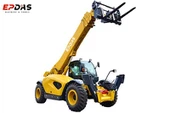
A telescopic forklift, commonly known as a telescopic arm forklift, is a type of forklift with a boom (long arm), and its forks or telehandler forklift attachments are usually installed on the telescopic arm to achieve the handling and stacking of goods through the telescopic action of the telescopic arm. It can be extended to higher heights and farther distances. Unlike traditional forklifts, telescopic forklift arms allow for greater range of motion and flexibility. This makes telescopic forklifts an ideal choice for construction sites, agricultural operations, and other outdoor applications that require climbing or working in confined spaces.
And the rough terrain telescopic forklift also has excellent off-road performance. They are capable of stable driving on rugged terrain and efficient cargo handling and stacking operations. This off-road performance makes telescopic forklifts widely used in complex environments such as construction sites and mines. In addition, the biggest function of the telescopic arm forklift truck is that it can realize the replacement of a variety of parts. Such as buckets, spreader, fork, working platform, fixture, etc., to achieve a multi-purpose machine, reduce the operating cost.
The birth of telescopic arm forklift mainly solved the technical problem of automatic leveling of forks. Traditional forklifts rely on vertical gantry lifting to adjust the operating height, and the fork plane remains horizontal during the lifting process and will not change. The telescopic arm forklift relies on adjusting the angle of the telescopic arm to change the height of the fork, and the plane angle of the fork changes with the angle of the telescopic arm.
The difference between forklifts and telescopic forklifts
1. Function and flexibility:There are significant differences in functionality and flexibility between extend boom forklifts and regular forklifts. The telescopic arm forklift achieves the handling and stacking of goods through the telescopic action of the telescopic arm, which has higher flexibility and adaptability. However, ordinary forklifts are limited by fixed masts and forks, and can only operate on relatively spacious and flat surfaces.
2. Off-road performance:Off road performance is another important difference between telescopic forklifts and regular forklifts. Rough terrain telescopic forklift has excellent off-road performance, with large diameter and wide base off-road tires that have a large contact area, which can disperse the weight of the vehicle, reduce pressure on the ground, and improve stability and passability on soft or slippery surfaces. However, ordinary forklifts usually do not have off-road performance and can only drive on flat roads. In situations where off-road performance is required, telescopic forklifts have an advantage.
3. Aerial working capability:Telescopic forklifts typically have higher capabilities for high-altitude operations. Their telescopic arms can be raised and lowered to higher heights, and the arm of the telescopic forklift can also rotate and tilt, further improving its high-altitude operation capability. However, ordinary forklifts are limited by fixed masts and can usually only operate on the ground.
4. Accessories and versatility:Forklift with extendable boom are usually equipped with various accessories that can be selected and replaced according to different operational needs, making them more widely applicable. However, ordinary forklifts are usually only equipped with fixed forks and cannot be replaced or adjusted according to operational needs.
In summary, when choosing between a telescopic forklift and a traditional forklift, it is important to consider your specific operational needs. Although traditional forklifts are highly suitable for indoor use on flat and sturdy surfaces, telescopic forklifts have greater versatility for outdoor tasks, rugged terrain, and high-altitude applications. Understanding these differences will ensure that you choose the appropriate equipment based on specific needs, helping to optimize efficiency, safety, and productivity in operations.