

Hey there! I'm a supplier of 33m concrete boom pumps, and today I wanna chat about how to calculate the delivery capacity of a 33m concrete boom pump at different distances. It's super important for construction projects, as getting the right delivery capacity ensures everything runs smoothly and efficiently.
First off, let's understand what we mean by delivery capacity. It's basically the amount of concrete that the boom pump can move from the mixing site to the pouring location within a certain time frame, usually measured in cubic meters per hour (m³/h). A 33m concrete boom pump is a great choice for many medium - sized construction jobs, offering a good balance between reach and capacity.
Factors Affecting Delivery Capacity
There are several factors that can impact the delivery capacity of a 33m concrete boom pump at different distances.
1. Pump Specifications
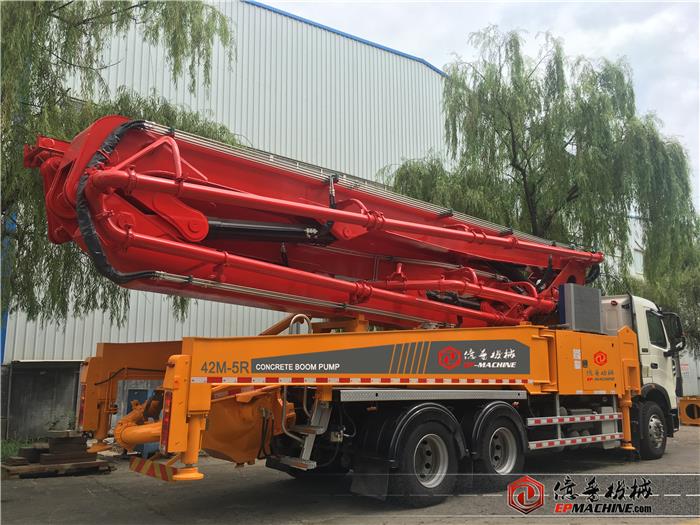
The design and technical specs of the pump itself play a huge role. Different models of 33m concrete boom pumps have different maximum delivery capacities. For example, some pumps might be able to deliver up to 90 m³/h under ideal conditions, while others could top out at 60 m³/h. The pump's motor power, the size of the concrete cylinders, and the efficiency of the pumping system all contribute to these differences.

2. Concrete Properties
The characteristics of the concrete also matter a lot. The slump, which is a measure of the concrete's consistency, affects how easily it can flow through the pump and the boom. A higher slump means the concrete is more fluid and can be pumped more quickly. Aggregate size and type are also important. Larger aggregates can cause blockages in the pumping system, reducing the delivery capacity.
3. Distance and Height
As the distance from the pump to the pouring point increases, the delivery capacity generally decreases. This is because the concrete has to travel further through the pipes, and there's more friction and resistance. The same goes for height. Pumping concrete uphill requires more energy, and the delivery capacity will be lower compared to pumping on a flat surface.
Calculating Delivery Capacity at Different Distances
Now, let's get into the nitty - gritty of calculating the delivery capacity at different distances.
Step 1: Know the Pump's Maximum Capacity
First, you need to find out the maximum delivery capacity of your 33m concrete boom pump. This information is usually provided by the manufacturer in the pump's technical manual. Let's say our pump has a maximum capacity of 80 m³/h under ideal conditions.
Step 2: Consider the Friction Loss
Friction loss occurs as the concrete moves through the pipes. The longer the pipes, the greater the friction loss. A general rule of thumb is that for every 10 meters of horizontal distance, the delivery capacity can decrease by about 5 - 10%. For vertical distance, every 10 meters of height can cause a 10 - 15% reduction in capacity.
Let's take an example. Suppose we need to pump concrete to a point that is 20 meters horizontally and 10 meters vertically away from the pump.
For the horizontal distance:
Since every 10 meters of horizontal distance can cause a 5 - 10% reduction, for 20 meters, we'll assume a 15% reduction.
For the vertical distance:
Since every 10 meters of vertical distance can cause a 10 - 15% reduction, we'll assume a 12% reduction.
The total reduction percentage can be calculated using a combined approach. A simple way is to add the reduction percentages, but this is a rough estimate. In our case, the total reduction percentage is approximately 15%+12% = 27%.
Step 3: Calculate the Delivery Capacity
To calculate the delivery capacity at the given distance, we use the following formula:
Delivery Capacity = Maximum Capacity×(1 - Total Reduction Percentage)
Using our example, with a maximum capacity of 80 m³/h and a total reduction percentage of 27% (or 0.27), the delivery capacity is:
Delivery Capacity = 80×(1 - 0.27)=80×0.73 = 58.4 m³/h
Using Online Calculators and Software
If you don't want to do these calculations by hand, there are many online calculators and software programs available. These tools take into account various factors such as pump specifications, concrete properties, distance, and height to give you a more accurate estimate of the delivery capacity. Some of these calculators are free, while others might require a subscription.
Related Products
If you're interested in other types of concrete pumps, we also offer Truck Mounted Concrete Pump and 37m Concrete Boom Pump. The Concrete Boom Pump Truck is another great option, providing mobility and high - performance pumping capabilities.
Conclusion
Calculating the delivery capacity of a 33m concrete boom pump at different distances is crucial for planning construction projects. By considering factors like pump specifications, concrete properties, and distance, you can get a good estimate of how much concrete the pump can deliver. Whether you're doing the calculations by hand or using online tools, it's important to have a clear understanding of the process.
If you're in the market for a 33m concrete boom pump or have any questions about calculating delivery capacity, feel free to reach out. We're here to help you make the right choice for your construction needs.
References
- Concrete Pumping Handbook - A comprehensive guide on concrete pumping technology and calculations.
- Manufacturer's technical manuals for 33m concrete boom pumps.